About 1 in 345 children in the United States has been identified with cerebral palsy, according to a CDC estimate based on 8-year-olds in 2010 (1, 2). The CDC describes it as the most common motor disability in childhood. Parents who look into stem cell treatment for a child with cerebral palsy mostly find testimonials. A testimonial describes one family and one result, usually a good one, and it gives no numbers.
This article gives the numbers from Beike’s own records. Between 2011 and 2026, Beike collected 640 follow-up forms for cerebral palsy, covering 256 patients and 302 courses of treatment. Families filled in an initial form and then further forms 1, 3, 6 and 12 months after treatment. Each form asked what had changed in individual symptoms, in general physical condition and in quality of life.
The forms do not add up to one overall result. Some symptoms were reported as improved on most forms. Walking and standing, which are often what families most want to change, were reported as improved least often.
What kind of data this is
The forms are an observational record. There was no control group and no blinding, so it is impossible to know what would have happened to the same patients without treatment.
The treatment is not an FDA-approved therapy. No stem cell product is approved by the FDA for cerebral palsy or for any other neurological disorder (3), and Beike’s treatment is not available in the United States. The figures below also cannot predict how any one child will respond.
Results varied widely by symptom
The table gives, for each symptom, the share of valid answers that reported some improvement. Blank answers are left out.
| What was asked about | Reported some improvement | Answers |
|---|---|---|
| Range of motion | 78% | 580 |
| Spasticity (muscle tightness) | 76% | 566 |
| Arm and leg strength | 74% | 585 |
| Swallowing | 68% | 474 |
| Speech, or babbling in infants | 65% | 458 |
| Balance | 61% | 567 |
| Drooling | 56% | 470 |
| Standing | 46% | 495 |
| Walking | 39% | 463 |
About four in five answers reported easier range of motion. Fewer than two in five reported a change in walking.
Spasticity, range of motion and strength are at the top of the table. Standing and walking are at the bottom by a wide margin. For a parent, this order says more than any single percentage, because the symptoms differ in how much they affect an ordinary day. Looser hamstrings can make dressing and positioning easier without moving a child from level IV to level III of the Gross Motor Function Classification System (GMFCS), the five-level scale used to grade mobility in cerebral palsy (4).

Reported improvement by symptom, with the number of answers to each question.
The number of answers differs from question to question. Each symptom was answered on between 458 and 585 of the 640 forms, which means that between 9 and 28 percent of forms left a given question blank or marked it as not applicable. The records do not show which families skipped which questions, or why.
Many forms reported no change and a few reported worsening
The forms also record answers of no improvement and of worsening.
For walking, no improvement was reported more often than improvement, at 61 percent against 39 percent. Standing was close to an even split, with 54 percent reporting no change. Drooling differs from the other symptoms. Improvement was reported in 56 percent of answers, but 5.5 percent said the symptom was worse than before treatment, which is the highest rate of worsening in the dataset. For the other symptoms, reported worsening stayed under 2 percent.

Improved, unchanged or worse, by symptom.
Quality of life was rated higher than motor function
The forms ask about general physical condition and about quality of life in two separate questions. Across valid answers, 82 percent reported some improvement in physical condition and 84 percent in quality of life. The quality of life figure is slightly higher than the physical one and much higher than the figures for walking or standing.
There are two plausible explanations. Caregiving may have become easier in ways that a question about motor function does not capture, such as better positioning, easier transfers, therapy sessions the child tolerates better, or a child who engages more. The second explanation is expectation. Parents who have put money, hope and a long flight into a treatment tend to look hard for gains, and quality of life is the most subjective item on the form. The numbers are consistent with both explanations and rule out neither.
Later forms did not report more improvement
If the benefit of treatment built up steadily over time, later forms would look better than earlier ones, and they do not.
Reported improvement in general physical condition drifts slightly downward across the follow-up points, from 84.5 percent on the initial form to 83.0, 82.4 and 81.4 percent, and then 79.6 percent at 12 months. Quality of life moves the other way and less smoothly. It starts at 75.5 percent, rises to 81.8 and 82.5 percent, peaks at 89.1 percent at 6 months and stands at 85.3 percent at 12 months.

Reported improvement in general physical condition and quality of life at each follow-up point.
Each follow-up point is a different set of forms. The same children were not tracked through all five points, so the chart does not show a trajectory. Families who saw little change may also have been less likely to keep sending in forms, which would push the later figures up. The chart is a reason to ask what can be expected at 6 and 12 months, and it should not be read as a forecast.
Rehabilitation could explain part of the result
A pediatric neurologist reading these results would point to the rehabilitation. Beike’s cerebral palsy program is more than a stem cell infusion. It combines cell treatment given in several injections with a course of intensive daily rehabilitation, and rehabilitation has effects of its own. A systematic review of interventions for children with cerebral palsy found good evidence that strength training improves muscle strength and that intensive, task-specific motor training improves motor function (5). In the Duke University trial described below, the children who received a placebo also gained more motor function over a year than was expected for their age and severity. The authors suggested that this may reflect the therapies those children were receiving (6).
The improvements reported on the forms could therefore have come from several weeks of intensive rehabilitation, with or without cells. This dataset cannot separate the two, and nobody should claim on the basis of it that the cells caused the reported changes.
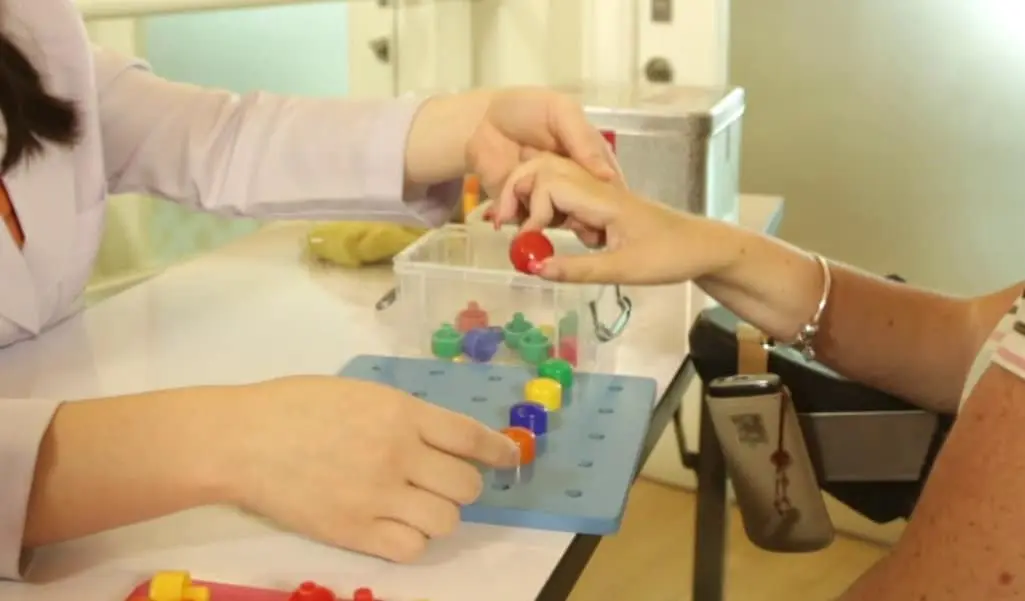
Daily rehabilitation, such as occupational therapy, is part of the treatment program.
What US research has found
The most relevant American work is at Duke University, where Dr. Joanne Kurtzberg’s team has run controlled trials of cord blood cell therapy in cerebral palsy. A placebo-controlled phase II trial randomized 63 children aged 1 to 6 to a single infusion of their own cord blood (32 children) or a placebo (31 children) (6). It did not meet its primary endpoint. After one year, scores on the GMFM-66 motor function scale had risen by an average of 7.5 points in the cord blood group and 6.9 points in the placebo group, a difference that was not statistically significant. An exploratory analysis did find a signal related to dose. The 9 children who received at least 20 million cells per kilogram of body weight improved by a median of 4.3 points more than expected for their age and severity. The placebo group improved by 2.2 points more than expected, and the lower-dose group finished 1.9 points below expectation. Dose was not assigned at random, and the high-dose group was small.
A later open-label randomized trial from the same team, published in Developmental Medicine & Child Neurology in 2022, tested donor cord blood and cord tissue mesenchymal stromal cells in 91 children (7). Its authors concluded that cord blood should be tested further in a randomized, blinded, placebo-controlled trial.
The evidence so far is mixed and depends on dose. It also comes from trials run under conditions very different from a treatment package that combines cells with intensive rehabilitation.
US regulators have taken a position as well. The FDA states that the only stem cell products approved in the United States are blood-forming stem cells derived from umbilical cord blood, and that these are approved for disorders that affect the production of blood and for no other use (3). The agency has sent warning letters and other letters to companies, clinics and health care providers offering unapproved stem cell products (8). In 2018 the Federal Trade Commission settled a case against a California physician and his two companies over unsupported claims that “amniotic stem cell therapy” could treat conditions including cerebral palsy (9).
Any family considering treatment abroad should first read the ISSCR Guide to Stem Cell Treatments (10) and search ClinicalTrials.gov for US trials that are enrolling.
What these records can and cannot show
The records cannot estimate efficacy, establish that stem cells caused any change, or predict an individual result.
They can set expectations more precisely than a testimonial does. The forms show a range. Some functions were often reported as improved, some rarely, and a small group of families reported that a symptom got worse. For a family weighing this decision, specific questions are the useful ones. What changed for children at my child’s GMFCS level? What share of families reported no change in the function I care about most? How much of the reported gain might the rehabilitation alone explain?
These questions should be put to the family’s own neurologist as well as to any clinic.
References
- Durkin MS, Benedict RE, Christensen D, Dubois LA, Fitzgerald RT, Kirby RS, et al. Prevalence of cerebral palsy among 8-year-old children in 2010 and preliminary evidence of trends in its relationship to low birthweight. Paediatr Perinat Epidemiol. 2016;30(5):496-510. doi:10.1111/ppe.12299
- Centers for Disease Control and Prevention. Data and Statistics for Cerebral Palsy. Last reviewed 2 May 2022 (archived page). archive.cdc.gov/www_cdc_gov/ncbddd/cp/data.html. Accessed 2 October 2026.
- U.S. Food and Drug Administration. Important Patient and Consumer Information About Regenerative Medicine Therapies. Content current as of 8 April 2024. fda.gov. Accessed 2 October 2026.
- Palisano R, Rosenbaum P, Walter S, Russell D, Wood E, Galuppi B. Development and reliability of a system to classify gross motor function in children with cerebral palsy. Dev Med Child Neurol. 1997;39(4):214-223. doi:10.1111/j.1469-8749.1997.tb07414.x
- Novak I, Morgan C, Fahey M, Finch-Edmondson M, Galea C, Hines A, et al. State of the Evidence Traffic Lights 2019: systematic review of interventions for preventing and treating children with cerebral palsy. Curr Neurol Neurosci Rep. 2020;20(2):3. doi:10.1007/s11910-020-1022-z
- Sun JM, Song AW, Case LE, Mikati MA, Gustafson KE, Simmons R, et al. Effect of autologous cord blood infusion on motor function and brain connectivity in young children with cerebral palsy: a randomized, placebo-controlled trial. Stem Cells Transl Med. 2017;6(12):2071-2078. doi:10.1002/sctm.17-0102
- Sun JM, Case LE, McLaughlin C, Burgess A, Skergan N, Crane S, et al. Motor function and safety after allogeneic cord blood and cord tissue-derived mesenchymal stromal cells in cerebral palsy: an open-label, randomized trial. Dev Med Child Neurol. 2022;64(12):1477-1486. doi:10.1111/dmcn.15325
- U.S. Food and Drug Administration. FDA sends warning to company for selling unapproved umbilical cord blood and umbilical cord products that may put patients at risk. News release, 3 September 2019. fda.gov. Accessed 2 October 2026.
- Federal Trade Commission. FTC Stops Deceptive Health Claims by a Stem Cell Therapy Clinic. Press release, 18 October 2018. ftc.gov. Accessed 2 October 2026.
- International Society for Stem Cell Research. The ISSCR Guide to Stem Cell Treatments. February 2024. aboutstemcells.org/patient-guide. Accessed 2 October 2026.