
For the millions of people living with chronic and autoimmune conditions, the promise of stem cell therapy has long offered hope. Today, that hope takes a significant step closer to reality.
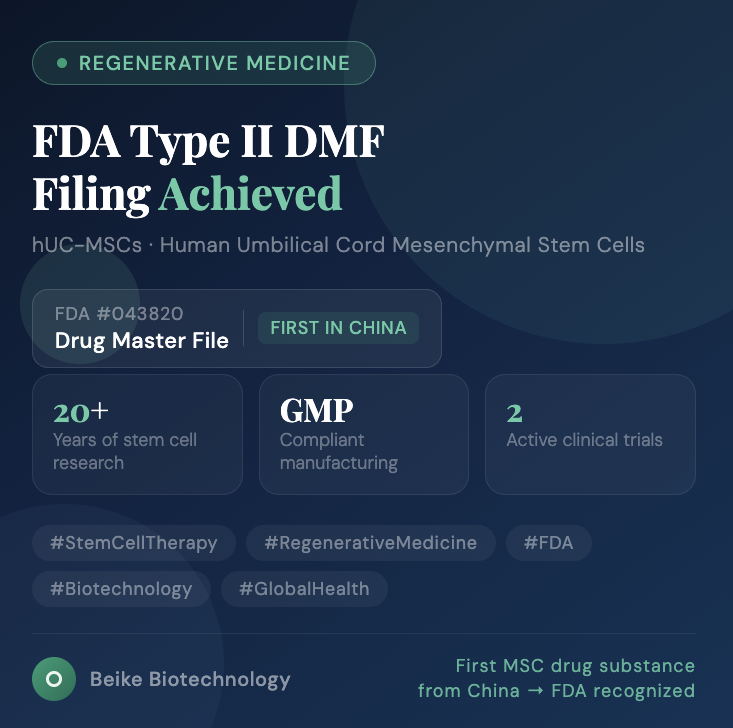
Beike Biotechnology has announced that its Human Umbilical Cord Mesenchymal Stem Cells (hUC-MSCs) have been granted a Type II Drug Master File (DMF) filing by the U.S. Food and Drug Administration (FDA #043820). This makes Beike the first mesenchymal stem cell company in China to receive this level of recognition from the FDA, a milestone that carries real significance for patients, researchers, and the future of global medicine.
What Is a Drug Master File, and Why Does It Matter?
A Drug Master File (DMF) is a confidential submission to the FDA that provides detailed information about the facilities, processes, and materials used to manufacture a drug substance. For stem cell therapies, receiving this filing is a powerful signal: it means the product meets the rigorous standards the FDA expects for safety, quality, and manufacturing consistency.
In plain terms: the FDA has reviewed and accepted detailed documentation on how Beike’s stem cells are produced, stored, and tested. This is not a treatment approval, but it is an essential foundation for one. It is the kind of scientific credibility that opens doors to international clinical trials, research partnerships, and ultimately, wider patient access.
What makes this milestone significant?
Beike Biotechnology has been advancing stem cell science for over 20 years. This milestone reflects that depth of commitment. Here is what underpins it:
- Two decades of research and innovation. Beike’s hUC-MSC program is built on more than 20 years of dedicated stem cell science, from early laboratory studies to established clinical programs.
- Full regulatory compliance. The manufacturing process is aligned with FDA guidelines, Good Manufacturing Practice (GMP) standards, and international regulatory frameworks – meaning the science is held to the same bar as leading pharmaceutical companies worldwide.
- Scalable, consistent production. Using closed-system manufacturing technology, Beike can produce high-quality stem cells at scale, a critical factor in making any therapy available to patients beyond a small research group.
Active clinical trials. Beike’s hUC-MSCs are already being studied in clinical trials for Systemic Lupus Erythematosus (SLE) and Crohn’s disease – two conditions that remain difficult to treat with existing therapies.
What this means for patients
If you or someone you love is living with a chronic autoimmune condition, the significance of this announcement may not be immediately obvious. Here is the straightforward version: achieving FDA Drug Master File status is one of the key steps on the path toward a therapy being studied, validated, and eventually made available through recognized medical channels.
It means that the cells being studied have been produced under conditions that meet one of the world’s most rigorous regulatory standards. It means that researchers in the United States and globally can reference this filing when pursuing collaborative studies. And it means that Beike’s work is being conducted with the transparency and accountability that patients deserve.
A shift for the field
This milestone is not just about one company. It represents a broader shift happening in regenerative medicine: the move toward globally standardized, rigorously verified stem cell therapies.
For too long, stem cell therapy has existed in a fragmented landscape – promising in research, inconsistent in practice, and difficult for patients to evaluate with confidence. Regulatory milestones like this one help change that. They create shared standards, increase scientific accountability, and build the foundation of trust that any medical field needs to serve patients well.
Looking ahead
Beike Biotechnology will continue advancing its clinical programs and research initiatives with the same commitment to quality and transparency that led to this recognition. We believe that stem cell therapy, developed rigorously and made accessible responsibly, has the potential to change lives, and this milestone is a meaningful step toward that future.
We are proud of what this represents – for our team, for the field, and most importantly, for the patients we are working to serve.